Resin & Acrylic Stabilisation – Processes

English Handmade Knives has its own stabilisation set-up. We will [...]
English Handmade Knives has its own stabilisation set-up.
We will provide information so that the techniques are easily understood and maybe inspire you try making your own, but you can always contacts us below to find out prices from us.
For knife handles it’s almost all resin stabilisation – its replacing the air and water in the wood with a hard plastic so it won’t move, crack, or soak up water later.
There are two completely different families of stabilisation
Resin / Acrylic Stabilisation – what you want for knife scales and handle blocks
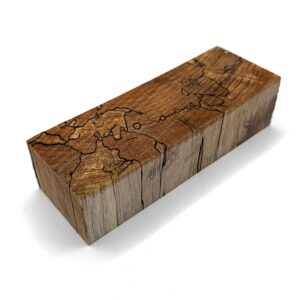
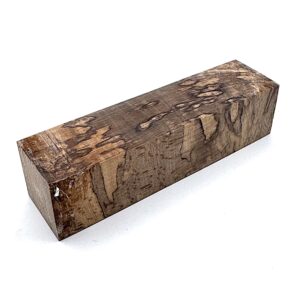
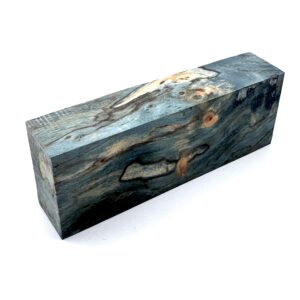
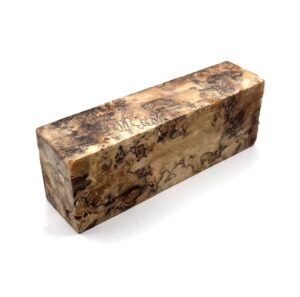
This is the standard for burls and blocks Spalted Elm – Poplar Burl – Box Elder – Curly Birch – Spalted Maple – Spalted Beech – Sycamore – Pine and we hold stocks of these.
Chemicals used:
Heat-cured acrylic monomer – This is 90% of what people use now. Brand names are Cactus Juice, Gator Venom, Minwax Wood Hardener is a similar idea. The base chemical is methyl methacrylate or similar low-viscosity acrylic monomers. Very thin, so it wicks deep.
Methyl methacrylate (MMA) – The original industrial stabiliser. Same chemistry, needs a catalyst and heat.
Epoxy and Polyester resins
Epoxy is tougher but doesn’t penetrate as deep. It requires making small moulds and using them in our vacuum chamber and the resin has to be very fluid and slow setting. We hold stocks of Woolly Mammoth Bone and Cross cut Molar.
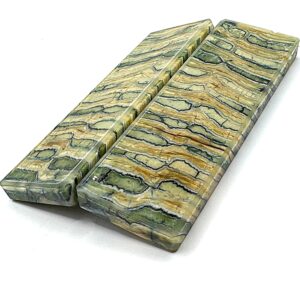
Mammoth Molar Stabilised Scales
Description
These scales will probably benefit from a G10 liner, this will prevent and problems when cutting and Drilling.
Book matched scales
Approx. size: 8.5 x 40 x 125 mm
Weight: 94 grams
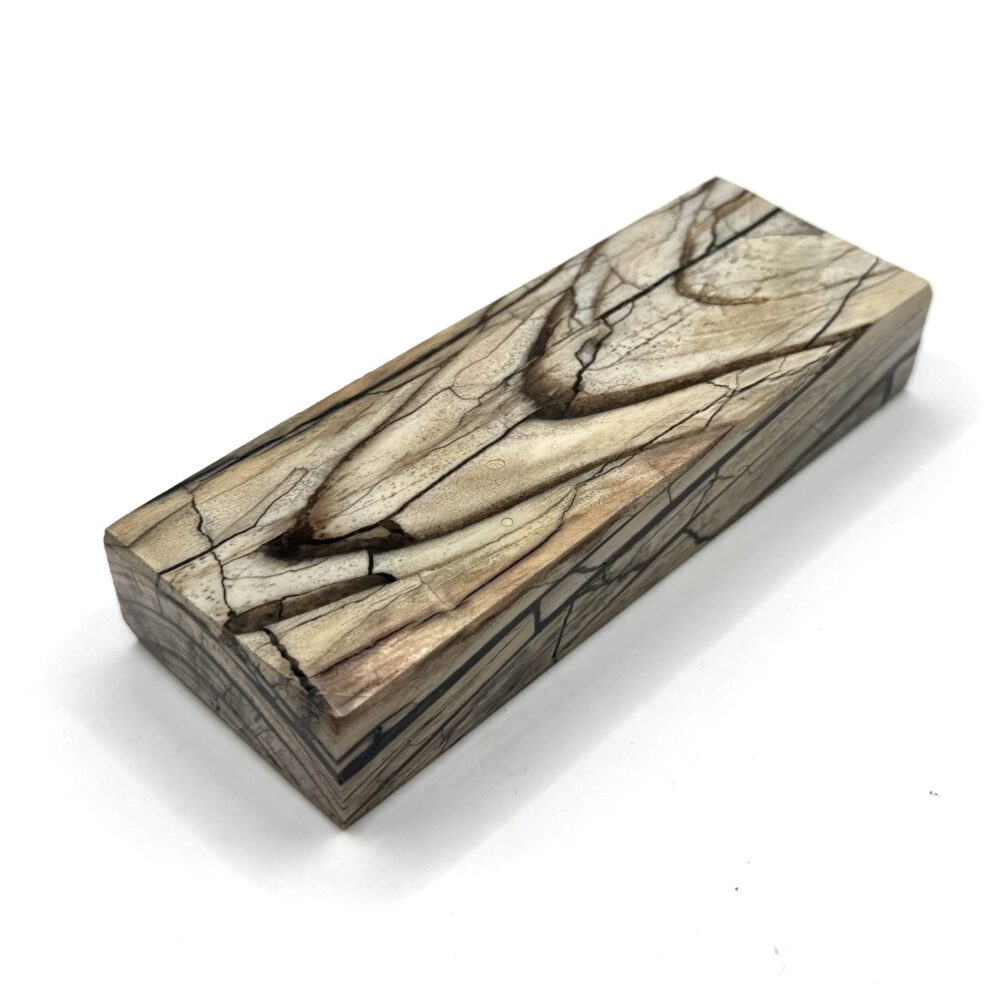
Stabilised Woolly Mammoth Tusk Block
Description
A very special block
Size: 23 x 40 x 120 mm
The woolly mammoth (Mammuthus primigenius) is an extinct species of mammoth that lived from the Middle Pleistocene until its extinction in the Holocene epoch. It was one of the last in a line of mammoth species, beginning with the African Mammuthus subplanifrons in the early Pliocene. The woolly mammoth began to diverge from the steppe mammoth about 800,000 years ago in Siberia. Its closest extant relative is the Asian elephant. The Columbian mammoth (Mammuthus columbi) lived alongside the woolly mammoth in North America, and DNA studies show that the two hybridised with each other. Mammoth remains were long known in Asia before they became known to Europeans. The origin of these remains was long debated and often explained as the remains of legendary creatures. The mammoth was identified as an extinct elephant species by Georges Cuvier in 1796.
Dyes
Usually aniline or alcohol-based dyes added to the resin so you can colour and stabilise at the same time.
Process:
Dry it bone dry: This is critical. Wood must be 0-8% moisture, ideally 0%. If there’s water inside, resin can’t penetrate. We use a moisture meter which is an essential part of our stabilising equipment.
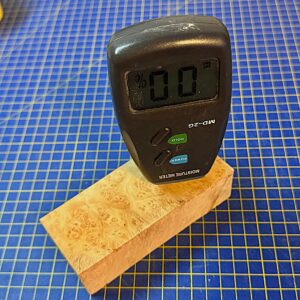
Vacuum impregnation: Put the dry blanks in a vacuum chamber, cover them completely in resin, and pull vacuum to about -25 to -29 Hg. The fluid boils like mad – that’s air being pulled out of the wood. Hold it until the bubbling stops, usually 30 mins to a few hours. Then release the vacuum. The atmospheric pressure now pushes resin deep into where the air was.
We usually leave our blocks to soak for an additional 24 hours and the bring the tank up to pressure one more time.
Curing: For Cactus Juice resin, we heat to polymerise it, then wrap each blank in foil and bake at 90-95C [195-200F] for 1.5-2 hours. It goes from wet to hard plastic inside the wood. It is exothermic, so we don’t overcrowd our toaster oven in the workshop.
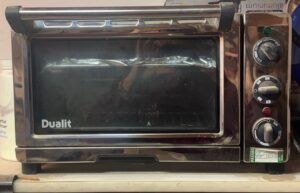
This process achieves wood that is now a wood-plastic composite and close to 100% heavier.
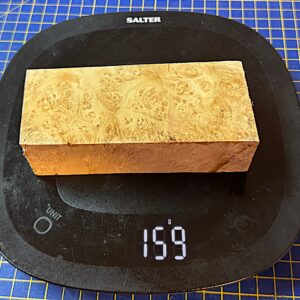
Before
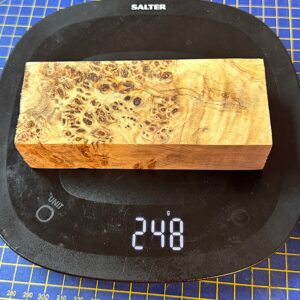
After
It will machine, sand and polish like dense hardwood, takes a high gloss, and is waterproof.
Practical tips:
- Spalted woods need two soaks. The first one locks the soft bits, the second finishes it.
- If the wood is oily – like olive or cocobolo – acrylic won’t take well. We clean with acetone before and expect less penetration.
- Safety: MMA vapour is flammable and an irritant. Our workshop is well ventilated, using nitrile gloves, respirator with organic vapour filters when baking. The cured plastic is inert.
Share This Article

Written by : Chris Matthews
Follow Us
Latest Articles
November 27, 2026
November 27, 2026
November 27, 2026