Firesnake & Firestorm Damascus – Explained

English Handmade Knives often gets asked how this pattern is [...]
English Handmade Knives often gets asked how this pattern is achieved – we hope this helps to explain the question
The process is fairly complicated so I am breaking the explanations down to be more understandable. Plus I have tried to capture with some simple photography of the processes
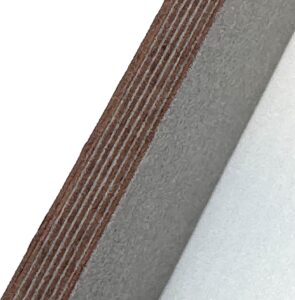
One: Stacked Flat Layered Billet, with alternating layers of high contrast 1084 + 15N20 steel- its easily welded for greater contrast.
Generally 15 to 40 layers Forging to a 30mm height
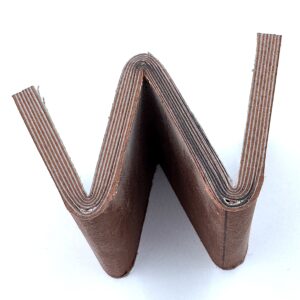
Two: The W’s are made this starts the process for the Firestorm pattern
Layers are folded in W/Zigzag pattern. This is the core move:
Ws, which are made by making multiple layers and crushing on edge.
a) Welding the flat stack solid at welding heat – around 1150-1200C / 2100-2200F.
b) The bar is Drawn it out to ~ 250-300mm long x 25mm wide x 12-15mm thick.
c) Its then turned 90 degrees on edge and forged down. Squashing the layers edge-wise so they buckle into Ws.
The Vs/Ws on the end grain can be seen.
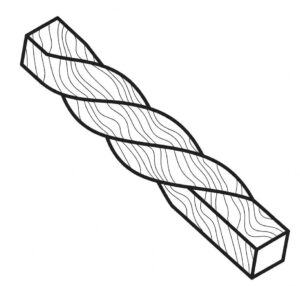
Three: Twist the bar.
The bar is heated and twisted along its length, twisting elongates and spirals the W-Pattern
Now the snake part.
a) A good welding heat along the whole bar is required, then clamp one end in a vice, twist wrench on the other.
b) Tight twist – 1 to 1.5 twists per inch. For Firesnake a fairly aggressive twist.
c) The bar is Straighten under a press/hammer at welding heat.
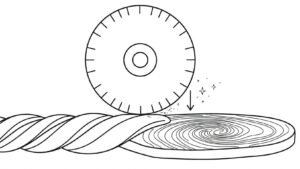
Four: Ground Flat to Expose the pattern
“When the twisted W patterns like firestorm and explosion, you have to grind 1/4 to 1/3 of the way into each side of the billet to really expose the pattern”
Grind both wide faces flat until you hit that deep W interior. Suddenly the radiating explosion pattern appears.
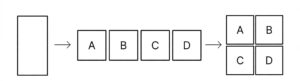 Five: the Firesnake tile
a) The twisted, ground bar is cut into 4 equal pieces – 60mm each.
b) The faces are cleaned, arrange in a 2 x 2 block. This is where Firesnake gets its name – two of the tiles are rotated 180 degrees so the Ws flow into each other like snakes.
c) The parameters are held, and re-welded into a solid mosaic block (End-on).
d) Draw (Forge) a block out into your blade billet. Keep the patterned face as the side of the knife. Don’t forge too thin – you want to leave 3-4mm for grinding after heat treat.
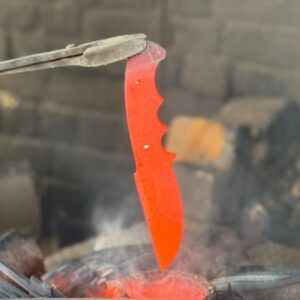 Six: Finish
Normalise: 3 x cycles – 870C, 815C, 760C, air-cooled
Hardening: 1084/15N20 – 815-830C, oil quench. Don’t overshoot, 15N20 will grow grain if too hot.
Temper: 175-200C twice for ∼58-60 HRC
Etch: Ferric chloride 30-40% diluted 3:1 with water, 10-15 min cycles. Light hand sand 2000 grit between etches to brighten the 15N20. Neutralise in bicarb.
I hope that you have all been able to gasp the basics and the processes
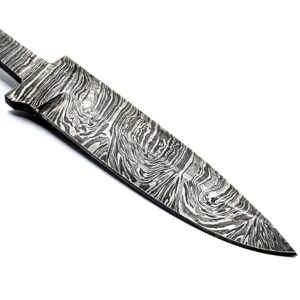
Tumbler – Firesnake Damascus Hunters Blade
Description
Dimensions:
Blade: 120 x 27 x 4mm.
Steel: Firesnake Damascus
Scandi Grind: with 172 Layers.
Very good smooth outline, this will make up into a beautiful knife
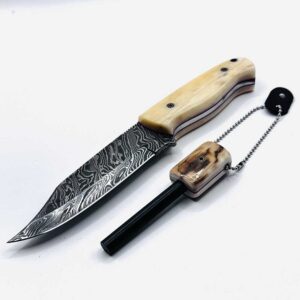
The New Firestorm Hunters Bowie
Description
Specifications and Materials
Style: Hunting and Bushcraft work
Blade: 110mm
Depth: 30mm
Overall Length: 235mm
Grind: Scandi with small secondary bevel and thumb grip along the top edge
Thickness: 3.75mm
Pattern: Firestorm
Layers: 256
Scales: Stabilised Natural Giraffe Bone (now covered by CITIES). With Stainless Steel Torx Scale fixings with 6.35mm Mosaic Pin small sections over the top, to add some extra style 0.8 red liners and a Lanyard Tube.
English Handmade Knives own design Sheath: Hand sewn 3.5mm veg tanned leather, wet moulded to fit the blade and handle, dyed Dark Brown and treated with Aussie Wax to give suppleness and protection against the elements.
Firesteel: 110mm with 9mm Rod, Woolly Mammoth Crust Handle and a retention tab
Weight: 476 grams
Share This Article

Written by : Chris Matthews
Follow Us
Latest Articles
November 27, 2026
November 27, 2026
November 27, 2026