San Mai Damascus – Explained

English Handmade Knives often gets asked how this pattern is [...]
English Handmade Knives often gets asked how this pattern is achieved – we hope this helps to explain the question
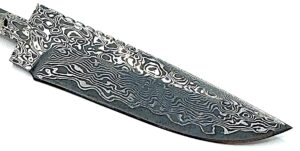
San Mai Damascus is made like this — hard core in the middle, Damascus cladding on both sides forming that edge.
This is the classic three-layer laminate.
San Mai (in Japanese means three layers) using two billets of pattern-welded Damascus for the jackets, and forge-weld them around a mono-steel core. Getting toughness and beauty on the outside, pure cutting performance in the middle.
Steel selection
Core: Is good edge steel. Common choices are: 1095, 80CrV2, 52100, Blue Paper (Aogami), White Paper (Shirogami). 80CrV2 is very forgiving for San Mai.
For the Damascus jackets: A simple contrasting mix 1084 + 15N20 (nickel bright layer). Both jacket billets are from the same Damascus batch so the pattern matches.
Thickness ratio: 30% core / 70% jacket total. Forging is a delicate process most blades end up after grinding and heat-treating 3.5-4mm
The Damascus billet is forged first
The billet is generally 80-150 layers, fully welded and consolidated. The Surface ground perfectly flat, this is extremely important no pits and no scale. Very critical could cause delamination later.
Preparation is very important
Both core and jacket faces to 120 grit, are then cleaned with acetone.
All three pieces must be the same length and width.
Everything is kept square. If the core wanders off-centre during forging its important – this is where skilled forging is required.
The three sections are welded together
Stack: Damascus / Core / Damascus – then weld. A light wash is used of anhydrous borax.
The San Mai weld
Welding heat — bright yellow, around 1150-1180°C for carbon. A soaking, even heat, not sparking. Firstly the hammer work is light and right in the middle to set the core, then worked outwards to push air out. The billet is Flipped and Repeated. Once set, the billet is drawn out gently. This takes three or four visits to the crucible to get to the right blade thickness.
A lot of care is taken to get every thing to an aesthetic perfection
Normalising and profiling
After forging, 3 x normalising cycles: 870°C, 830°C, 790°C, air cool. This is critical because different steels that are be stressed.
Then profiling, drill, and rough grind before heat treat.
Heat treat
Heat treatment is for the CORE steel, not the jackets. For example, 80CrV2 core: for example is taken to 830-850°C, quenching in warm oil.
The outer 1084/15N20 will be along for the ride — it’s there for toughness.
Tempering usually to 150-200°C twice for 2 hours for 60-61 HRC for the core.
Finish and etch
The finish is normally to at least 400 grit before etching.
The blade is cleaned thoroughly in very soapy water then dried using a cloth and not handled directly, finger prints will be problem.
Etch in Ferric Chloride 1:3 in water takes place for 5-15 minutes. TheC stays bright, the 1084 goes dark, and the core will be a solid grey line.
Neutralised in bicarb, light sanding at 1000-2000 grit to brighten the highs.
English Handmade Knives, have some stocks of San Mai Knives and Blades
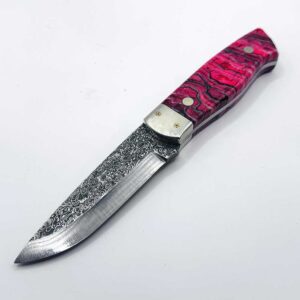
San Mai Trapper 95 – Custom Handmade Hunting & Bushcraft Knife
Description
A handmade fixed-blade knife built for the field and for the collection cabinet. The San Mai Trapper 95 is a versatile hunting, skinning and bushcraft knife, handcrafted in the UK from premium materials.
The name San Mai refers to its traditional three-layer blade construction. A hard stainless 440C core steel forms the cutting edge for exceptional edge retention, jacketed on both sides with iron/stainless for toughness and a striking layered look.
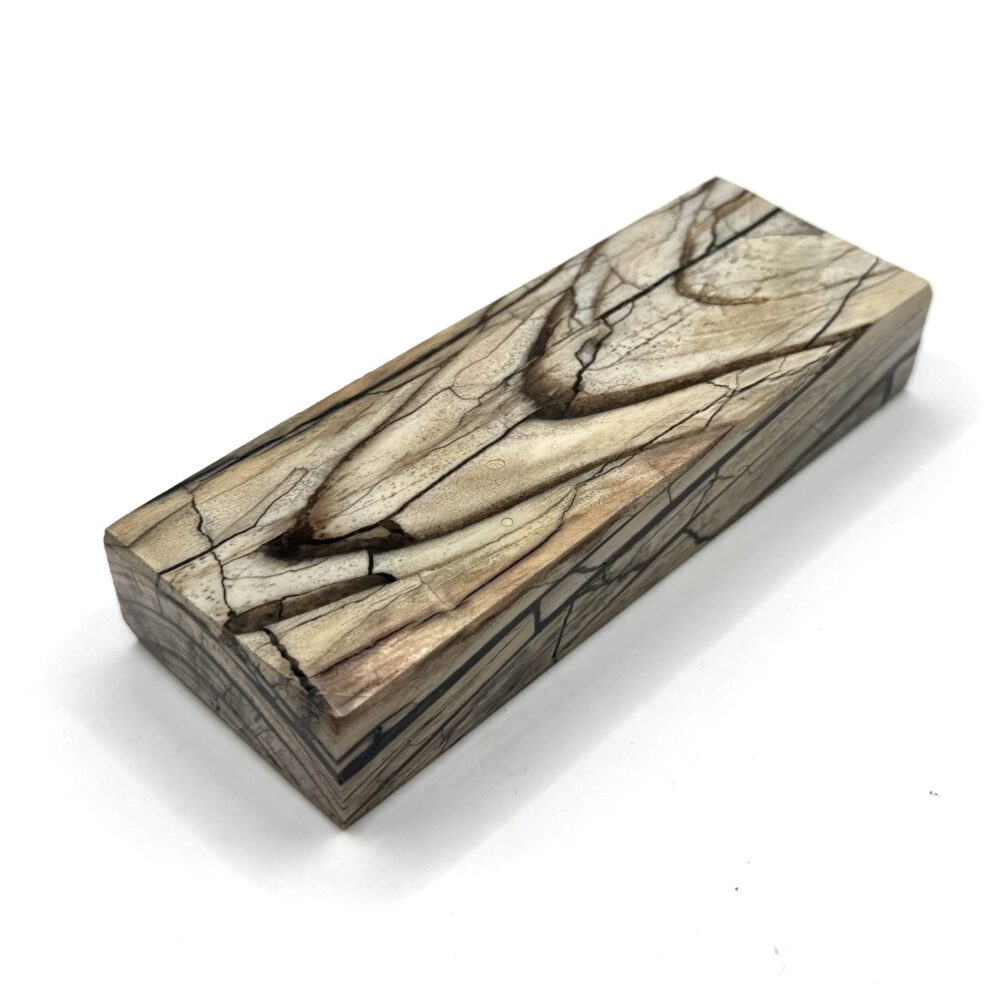
Each knife is finished with exceptionally rare stabilised Woolly Mammoth Molar scales, fitted with a 7mm nickel silver bolster, mosaic pins and nickel silver Corby bolts. No two handles are ever the same.
WHY COLLECTORS CHOOSE THE TRAPPER 95:
- Proven San Mai Performance: 440C cutting edge for easy field sharpening and long-lasting sharpness
- Rare Handle Material: Genuine stabilised Woolly Mammoth Molar – a true collector’s material
- Built for Use: Ideal 95mm blade for hunting, skinning, bushcrafting and general outdoor use
- Heirloom Quality: Nickel silver bolster and mosaic pins for durability and detail
- Custom Sheath Included: Western style, wet moulded, Ox-Blood leather
FULL SPECIFICATION:
Style: Hunting / Skinning / Bushcrafting / Collecting
Blade Steel: San Mai – Stainless 440C Core with Iron/ Raindrop Jacket
Blade Length: 95mm
Blade Width: 25mm
Blade Thickness: 3.5mm
Overall Length: 210mm
Scales: Stabilised Woolly Mammoth Molar with 7mm Nickel Silver Bolster, Mosaic Pins, Nickel Silver Corby Bolts
Sheath: Western Style, 3mm Vegetable Tanned Leather, Wet Moulded, Hand Stitched, Ox-Blood Dyed, Nickel and Leather Belt Loop, Treated with Aussie Wax
CUSTOM WESTERN LEATHER SHEATH:
Supplied with a snug-fit, wet-moulded western leather sheath. Hand stitched, dyed Ox-Blood, with special nickel and leather belt loop and treated with Aussie wax for weather protection. Individually moulded to match this blade for a secure, rattle-free fit.
Each Trapper 95 is handcrafted in the UK and supplied with its own custom leather sheath. Ideal for hunters, bushcrafters and collectors looking for a rare, heirloom-quality knife.
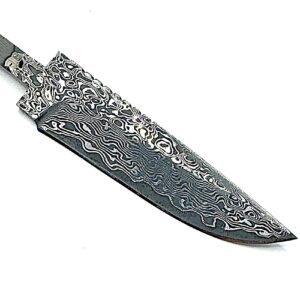
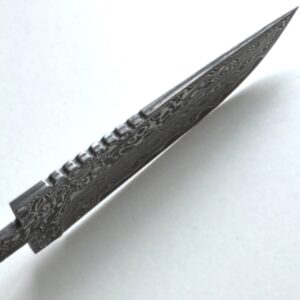
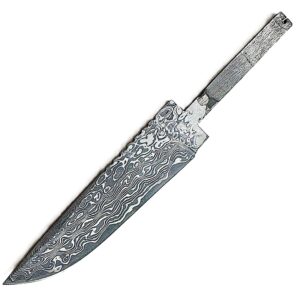
Tao San Mai Hunting Knife blade with stainless steel 8Cr13MoV in core.
Blade length: 85-90 mm
Blade width: 22 mm
Blade thickness: 3 mm
Total: 150 mm
Steel: 8Cr13MoV in core with Raindrop Damascus steel
Bolster: 3594
Share This Article

Written by : Chris Matthews
Follow Us
Latest Articles
November 27, 2026
November 27, 2026
November 27, 2026